Tired of Checking Logs on Each Server? How Does ELK Stack Help You Manage Centralized Logs for Free?
When a system has only 1-2 servers, SSH into each machine to run tail or grep commands to troubleshoot is still feasible. However, as the infrastructure expands to dozens or hundreds of servers, manually scanning logs is like “finding a needle in a haystack”. That is when you need a Centralized Logging system, and the ELK Stack is the leading open-source (free) solution.
What is ELK Stack? The role of each component
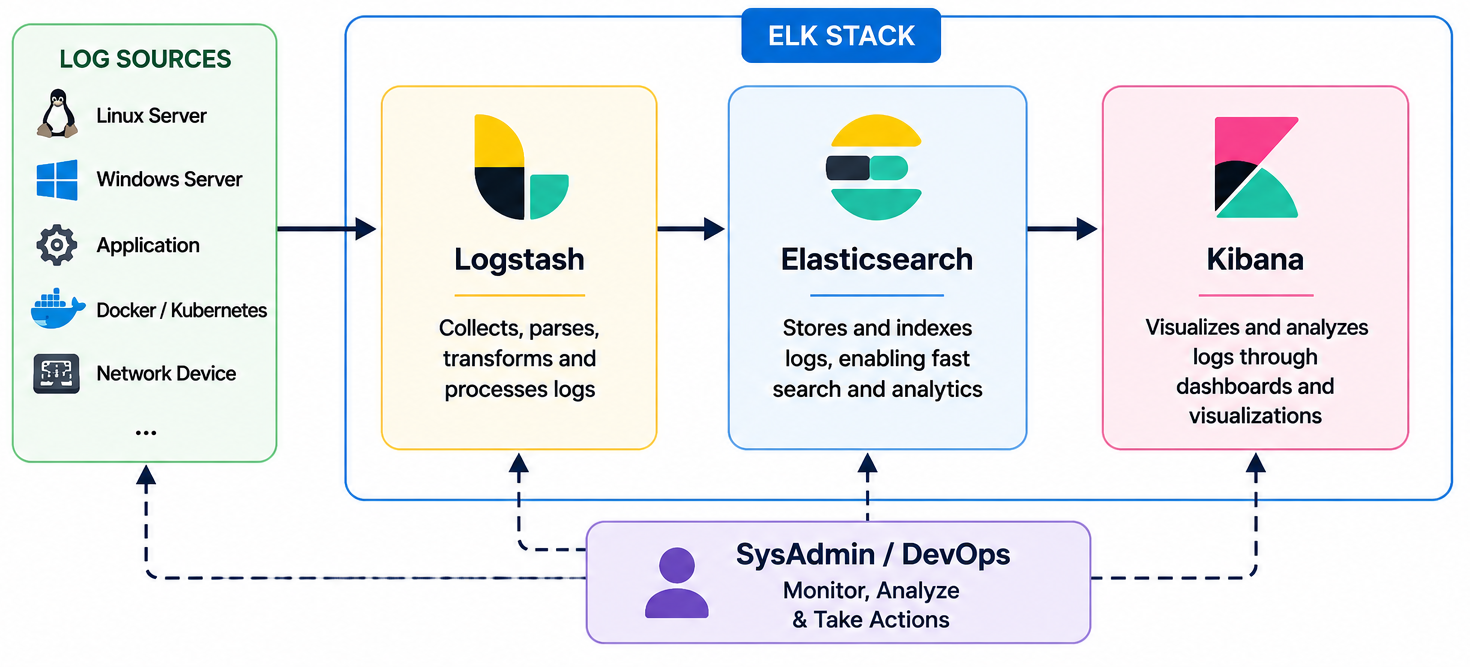
ELK is an acronym for three open-source tools that work seamlessly together to form a perfect data processing pipeline:
- Logstash (The Transporter & Processor): Acts as a collector, pulling logs from various sources (servers, applications, network devices). It then filters, parses, and transforms the data into a standardized format before forwarding it.
- Elasticsearch (The Storage & Search Brain): An exceptionally powerful Search Engine. It stores all the logs sent by Logstash and enables lightning-fast full-text searches across millions of log entries in mere milliseconds.
- Kibana (The Visual Interface): Provides an intuitive Web-based interface. Instead of staring at dry lines of text logs, Kibana allows you to build dynamic charts, graphs, and Dashboards for effortless monitoring and observation.
Log Shippers: Where does the data come from?
For the ELK Stack to function, we need tools to “collect” and “push” logs from source servers/devices to Logstash or Elasticsearch. The most common sources include:
· Beats (The Elastic Beats Family): Lightweight agents installed directly on servers to collect and forward data. Popular variants: Filebeat (reads log files), Metricbeat (collects CPU/RAM metrics), Winlogbeat (collects Windows event logs).
· Syslog: A standard protocol widely used by network devices (Routers, Switches, Firewalls) or Linux servers to send logs directly to Logstash via network ports (UDP/TCP).
· Other sources: Logs from Docker/Kubernetes, or applications pushing logs directly via HTTP REST APIs and Webhooks.