ModSecurity: How to Save Thousands of Dollars in Annual WAF Security Costs
Introduction to ModSecurity: Free Web Application Firewall (WAF) for Enterprises
In a landscape where cyber attacks targeting web applications (such as SQL Injection, XSS) are increasingly on the rise, protecting web servers is a top priority for any enterprise. Instead of investing thousands of dollars annually in expensive hardware WAF devices or Cloud services, ModSecurity offers an open-source, powerful, and completely free security solution.
1. What is ModSecurity?
ModSecurity is the world’s leading open-source Web Application Firewall (WAF). It acts as an intermediary layer of defense, sitting in front of popular web servers (like Apache, Nginx, IIS) to monitor all HTTP traffic in real-time and block attacks aimed directly at the website’s source code.
2. How ModSecurity Works
Unlike standard network firewalls that only block IPs and Ports, ModSecurity has the ability to “understand” the payload of HTTP packets. It operates based on a Rules Engine, most commonly combined with the OWASP Core Rule Set (CRS).
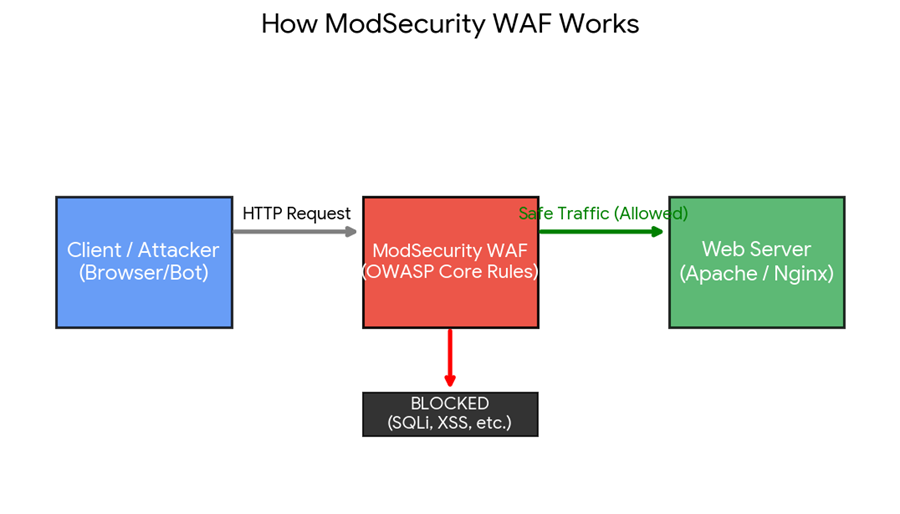
Illustration: ModSecurity WAF processing flow diagram
The protection process occurs in 3 steps:
· Request Analysis: Every access request from users (or hackers/botnets) sent to the server is intercepted by ModSecurity to inspect components like the Header, Body, and URL.
· Rule Matching: The collected data is matched against thousands of known attack patterns in the OWASP CRS rule set.
· Action: If the request is safe, it is passed to the Web Server for processing. If signs of malicious payloads are detected (like anomalous SQL code), ModSecurity immediately drops/blocks the connection and logs an alert for the administrator.
3. Outstanding Benefits for Enterprises
· Cost Optimization ($0): As open-source software, businesses can deploy a high-level security system without paying licensing fees.
· Compliance with International Security Standards: Deploying ModSecurity helps financial and e-commerce companies easily meet strict standards like PCI-DSS (which strictly requires a WAF).
· Zero-day Vulnerability Protection (Virtual Patching): When an application has a vulnerability that hasn’t been patched in code yet, SysAdmins can quickly write a custom Rule on ModSecurity to block exploitation attempts immediately.